AI will not make lawyers disappear, but “cognitive debt” could erode what makes them irreplaceable
For a year now, research has been measuring what unframed use of AI takes away from the person using it. Regulated professions are already supplying the first documented cases of deskilling — and a lawyer's own professional ethics contain the antidote.
Originally published in French on 13 August 2026 in le Village de la Justice.
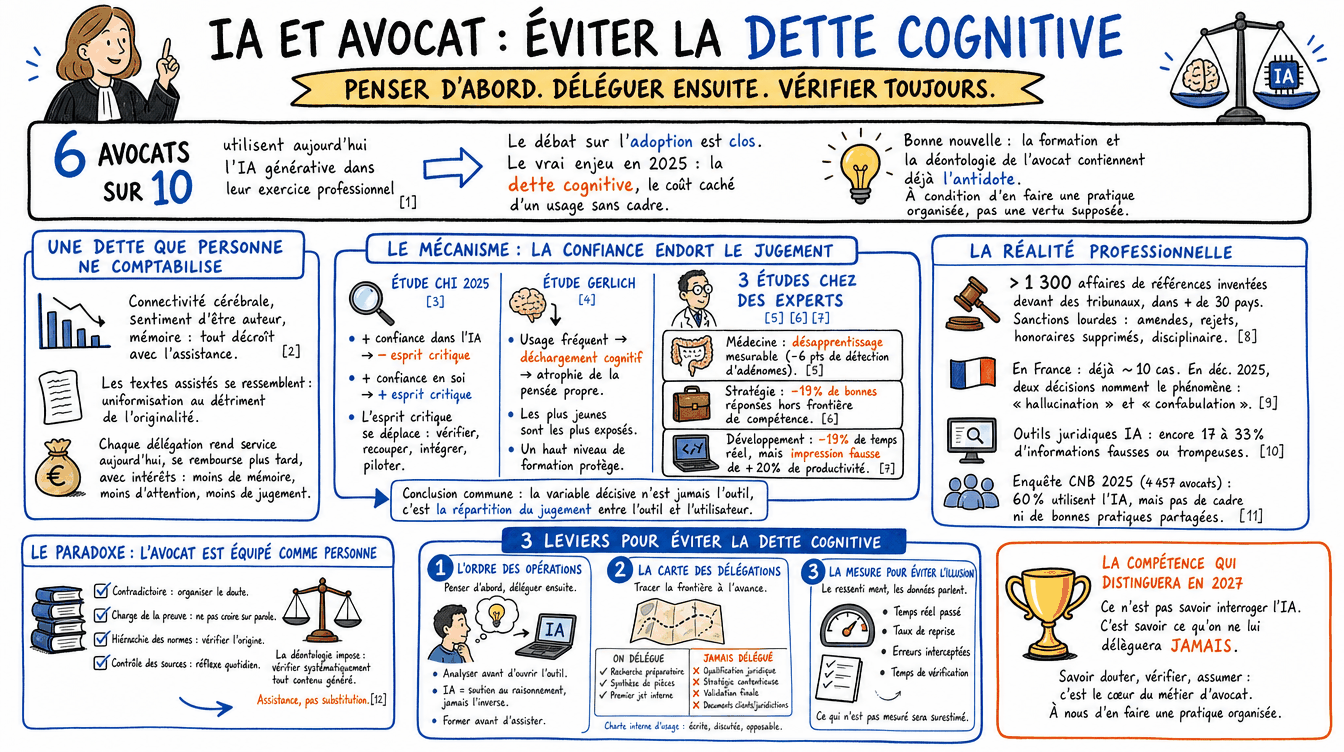
Six lawyers out of ten now use generative artificial intelligence in their professional practice [1]. The debate about adoption is therefore closed. But in 2025, research began measuring a cost nobody invoices: not what AI gets wrong, but what its unframed use takes away from the person using it. That risk has a name — cognitive debt.
It is documented, quantified, and it is already affecting regulated professions comparable to yours. The good news lies elsewhere: the legal profession holds the antidote, in its own training and in its own code of ethics.
On one condition — that it be made an organised practice, not an assumed virtue.
A debt nobody puts on the books
In June 2025, a team at the MIT Media Lab published a study with a deliberately provocative title: “Your Brain on ChatGPT” [2].
The setup is simple. Fifty-four participants write essays across several sessions spread over four months, split into three groups: some with a generative AI assistant, others with a conventional search engine, the last with no tool at all. While they write, an electroencephalogram measures their brain activity. The texts are then graded by teachers and analysed linguistically, and each participant is questioned about what they have just written.
The results are clear, and they line up like a staircase. Brain connectivity decreases as the level of assistance rises: strongest and most widespread among those working without a tool, intermediate among search-engine users, weakest among AI users. The sense of being the author of one's own text follows exactly the same slope. And the most striking detail: some of the AI users prove unable to quote a passage from the text they handed in minutes earlier.
The study notes another phenomenon, less commented on but telling for a professional writer: texts produced with assistance resemble one another. Cited entities, turns of phrase, chosen angles all converge within the AI group. The tool does not merely lighten the effort, it standardises the result. For a trade whose value rests on the argument the other side did not see, homogeneity is not a detail.
To describe the whole, the authors coin the term cognitive debt. The analogy with software engineers' technical debt is deliberate. It is invisible at the moment you take it on. Every delegation does you a favour today and is repaid later, with interest, in the form of memory that no longer fixes, attention that no longer engages, judgment that no longer gets exercised.
The limits of this work should be stated honestly: fifty-four participants, an academic setting, a publication still under peer review. It is a strong signal, not a law. But that signal converges with everything published since, across very different populations and methods.
The mechanism: trust puts judgment to sleep
What the following studies pin down is the mechanism. The cognitive cost does not come from the tool. It comes from the posture of the person using it.
A survey conducted by Microsoft Research and Carnegie Mellon University, presented at the CHI 2025 conference, questioned 319 knowledge workers about 936 real situations of generative AI use in their work [3].
The sheer volume of responses first gives the measure of the phenomenon: for the great majority of tasks examined, respondents report that AI reduces the mental effort they invest, and that reduction reaches even the highest-order operations — analysis, synthesis, evaluation. So far, nothing unexpected: that is the service the tool promises.
The central finding lies elsewhere, in a mirror effect. The more the user trusts the AI for the task, the less they exercise critical thinking. The more they trust their own competence on that same task, the more they exercise it, accepting that it costs them additional effort. The two forms of confidence pull in opposite directions, and it is the first that gains ground as the habit settles in. The study also notes that critical thinking does not disappear among vigilant users: it moves. It becomes verification of claims, cross-checking of sources, integration of answers, steering of the task. In other words, a supervision skill.
It still has to actually be exercised: among the identified obstacles, high on the list are simply not thinking of it, and the feeling that it is unnecessary since the tool is reliable.
A third study, conducted by Michael Gerlich on 666 participants of all ages and education levels, closes the triangle [4].
It establishes a significant negative correlation between how frequently AI tools are used and critical-thinking capacity, and identifies the intermediate link: cognitive offloading, that is, the habit of handing the tool the mental operations one used to perform oneself. The greater the trust in the tool, the more massive the offloading, and the more one's own thinking atrophies. The youngest users are the most exposed. A high level of education protects, whatever the level of use.
A common conclusion emerges from these three pieces of work, and it is rather reassuring to anyone willing to hear it: the decisive variable is never the tool. It is the distribution of judgment between the tool and the user. The debt is contracted at the precise moment you stop asking whether the machine is right.
Experienced professionals are already deskilling
The objection comes naturally: these studies cover students and office workers, not trained experts, still less professions whose practice engages liability. Three recent pieces of work answer it, and their answer is uncomfortable.
The first comes from medicine, and it deserves attention because it describes a regulated profession, highly expert, where error is expensive. In four Polish endoscopy centres taking part in a clinical trial, gastroenterologists spent three months using an AI that assists polyp detection during colonoscopy.
The assistance works: the literature establishes that it raises the detection rate while it is active. But a study published in The Lancet Gastroenterology & Hepatology asked the question nobody had asked: what happens when those same practitioners then work without the assistance [5]?
Their adenoma detection rate — the discipline's benchmark quality indicator, directly correlated with colorectal cancer prevention — falls from 28.4% to 22.4%. Six points lost in one quarter of exposure. Experienced specialists, in a discipline where every missed lesion can become a cancer, measurably deskilled. It is the first documented deskilling among practising professionals, and the authors soberly conclude that continued exposure to AI could degrade the operator's own behaviour.
The second comes from strategy consulting. A pre-registered experiment, run by Harvard researchers with the Boston Consulting Group on 758 consultants — a population recruited from the world's best universities — first shows everything AI brings [6]: across eighteen realistic tasks located inside its competence frontier, assisted consultants complete 12% more tasks, 25% faster, at a quality judged significantly higher. Then comes the trap task, designed to sit just beyond that frontier while resembling the others: assisted consultants produce 19% fewer correct answers than colleagues working without AI. The group that had received training in handling the tool does not escape the phenomenon.
The most troubling part is this: nothing, in the interface or in the apparent difficulty, tells the user which side of the frontier they are on. The authors describe seasoned professionals leaning on the machine precisely where it no longer carries, and speak of consultants falling asleep at the wheel.
The third concerns perception, and it is perhaps the most disturbing of the three. A randomised trial run by the METR institute followed seasoned developers working on their own projects, on codebases they have known for years [7].
Before the experiment, they predict AI will speed them up by 24%. The outside experts questioned — economists and domain specialists — predict even better. The measured result: with AI, those developers take 19% longer to complete their tasks. And questioned afterwards, having just lived through the experience, they remain convinced they were 20% faster. The impression of productivity is itself faulty. You cannot rely on how it feels to know whether the tool is helping: the feeling is precisely what the tool flatters.
Three different populations, three different methods, one same lesson.
Expertise does not protect. It only gives the illusion of protecting.
Law is already the demonstration
The profession does not need to borrow these examples from doctors or consultants. It supplies its own, and has done for longer than people think.
The first widely reported case dates back to spring 2023: Mata v. Avianca, before a federal court in New York, where lawyers filed a brief riddled with decisions invented by ChatGPT. It was seen at the time as an anecdote, the clumsiness of two careless colleagues. Three years later, the database maintained by researcher Damien Charlotin lists more than 1,300 cases of invented legal references filed before courts, in more than thirty countries [8]. Sanctions grow heavier decision after decision: fines sometimes in six figures, filings struck out, fees disallowed, referrals to disciplinary bodies. Lawyers are not the only ones concerned — the database contains judges and self-represented litigants — but they are the most sanctioned, because they are bound by a duty to verify that the others do not carry.
France already counts about ten cases. And two recent French decisions crossed a symbolic threshold by naming the phenomenon in their reasoning. On 18 December 2025, the Périgueux judicial court noted that references cited by a claimant matched no published decision, and invited the claimant and their counsel “to verify in future that the references they may have found on search engines or with the help of artificial intelligence are not "hallucinations"” [9].
Eleven days later, the Orléans administrative court did the same, found that the cited decisions did not exist or did not match the dates given, and used the words “hallucination” and “confabulation”.
The French bench now has the vocabulary, and it has started using it.
One might object that these accidents belong to consumer tools, and that professional solutions protect against them. The objection does not entirely hold. A Stanford team subjected the AI-augmented legal research tools of the largest publishers — sold with promises of no hallucination — to a pre-registered evaluation of more than 200 queries [10]: the products tested still produce false or misleading information in 17% to 33% of cases. That is markedly better than a general-purpose chatbot. It is far from the zero promised by the sales brochures, and the authors conclude that human verification of propositions and citations remains indispensable.
That leaves the question of how the French profession actually uses these tools. The survey conducted for the Conseil national des barreaux among 4,457 lawyers, in spring 2025, draws a precise picture [11]. Six lawyers out of ten use generative AI in their practice, three out of ten at an advanced level, only one out of ten refuses it. Lawyers turn to general-purpose AI as often as to specialised legal AI, and the most cited tool is not a legal product: it is ChatGPT. Those concerned are not fooled, as the survey shows: they have seen the inaccuracies and the invented case law, they know that systematic verification takes back part of the time saved. But the qualitative finding of the same survey matters most here: in the great majority of firms, there is no formalised approach, no internal standards, no shared good practice. Everyone improvises their own use in their corner, with their own idea of what counts as careful.
The “for or against AI in the firm” debate is therefore obsolete. Adoption has happened. What has not happened is the framework.
The paradox: no one is better equipped than a lawyer
Let us now reread the mechanisms described by the studies in the light of that finding. What protects against cognitive debt comes down to three attitudes: trusting your own competence rather than the tool's, systematically verifying what is asserted, and refusing to hold a proposition true because it is well phrased.
Those three attitudes have a collective name: legal training. The adversarial principle, which turns doubt into procedure. The burden of proof, which forbids taking anything on trust. The hierarchy of norms, which requires checking where each rule comes from before applying it. Source-checking, a reflex acquired in the first year of law school. From the very beginning of their studies, the lawyer is trained to do precisely what researchers now recommend teaching to other professions.
Doubting a well-written text is their job. AI hallucinations are convincing because they have the exact appearance of the true; of all the intellectual professions, the lawyer is the one most systematically drilled not to confuse the appearance of truth with truth.
Professional ethics make it an obligation on top of that, not an optional virtue. The practical guide adopted by the Conseil national des barreaux requires systematic verification of any generated content before it is used or sent to a client or a court: reread, check, validate [12]. A lawyer who produces erroneous material for want of appropriate verification engages their civil liability and exposes themselves to disciplinary proceedings. The same guide bounds the tool's role with a formula Christiane Féral-Schuhl had already given in 2024: software “for assistance and not for substitution”. The CCBE guide, at European level, writes the same requirement into the continuation of the profession's essential principles: integrity, loyalty to the client, contribution to the sound administration of justice.
In other words, where other trades have to invent a discipline of verification from scratch, the lawyer only has to apply their own to a new object. Cognitive debt strikes those who delegate their judgment.
A lawyer's professional ethics forbid precisely that delegation. It still has to come down from principle into daily practice, and that is exactly what is missing today: the CNB survey shows a profession that is individually clear-sighted and collectively without a framework.
Framing, the firm's new competence
What remains is to turn that structural advantage into an organised practice. The studies cited above do not merely describe risks; read carefully, they sketch three concrete levers. All three are firm-level decisions rather than matters of individual skill.
The first is the order of operations. The most useful result of the MIT study is not about the risks, but about the counter-measure [13]. In a fourth session, the researchers swapped the groups. Participants who had always worked with AI and suddenly found themselves without it showed weakened brain engagement: the debt was being repaid. But those who had first worked unassisted, then received AI second, retained their memory recall and largely re-engaged their brain networks. Sequence protects: think first, delegate second.
In the firm, that means the analysis of the file happens before the tool is opened, and that AI drafts from reasoning already laid down, never the reverse. The rule counts double for training associates, who are — every study confirms it — the population most exposed to cognitive offloading: AI comes after the craft is learned, not in its place. An associate who has never built a chronology of exhibits alone will not be able to see what is missing from the one the machine hands back.
The second is the delegation map. The lesson of the BCG experiment is that the frontier between what AI does well and what it gets wrong is invisible to the user, trained or not [14]. It must therefore be drawn in advance, in writing, rather than discovered file by file. What can be delegated: preparatory research, the summary of voluminous exhibits, the first draft of an internal document. What is never delegated: legal characterisation, litigation strategy, final validation, and any document leaving for a client or a court. The CNB guide provides the basis for that division, down to a self-assessment grid for choosing tools [15]; each firm then has to translate it into the vocabulary of its own files, its own practice areas, its own risks. That is the purpose of an internal AI usage policy: a short document, binding on yourself, saying who uses what, for which tasks, with which verifications and which prohibitions. Its value does not lie in the paper, it lies in the discussion it forces: as long as the delegation map is not written down, it is each associate who draws it implicitly, alone, under deadline pressure.
The third is measurement. Since the feeling of productivity lies, as the METR trial showed [16], the real gain is verified on the record: time actually spent on assisted files, rework rate on first drafts, errors caught in review, the verification time itself. What is not measured will be overestimated, and the CNB survey suggests lawyers already sense it, noting as they do that systematic verification takes back part of the time saved [17]. A firm that measures knows what the tool earns it, task by task. A firm that does not measure believes it.
The question is no longer whether the firm uses artificial intelligence: six lawyers out of ten already do. The question is who, in the firm, decided how. Knowing how to write a prompt for an AI was the competence of 2024. Knowing what you will never delegate to it will be the one that sets firms apart in 2027.
Notes
- CNB, “L’intelligence artificielle et la profession d’avocat”, survey of 4,457 lawyers, fieldwork April–May 2025: cnb.avocat.fr.
- N. Kosmyna et al., “Your Brain on ChatGPT: Accumulation of Cognitive Debt when Using an AI Assistant for Essay Writing Task”, MIT Media Lab, June 2025 (preprint): arxiv.org/abs/2506.08872.
- H.-P. Lee et al., “The Impact of Generative AI on Critical Thinking: Self-Reported Reductions in Cognitive Effort and Confidence Effects From a Survey of Knowledge Workers”, CHI 2025, Microsoft Research / Carnegie Mellon University: doi.org/10.1145/3706598.3713778.
- M. Gerlich, “AI Tools in Society: Impacts on Cognitive Offloading and the Future of Critical Thinking”, Societies 15(1), 2025: doi.org/10.3390/soc15010006.
- K. Budzyń et al., “Endoscopist deskilling risk after exposure to artificial intelligence in colonoscopy: a multicentre, observational study”, The Lancet Gastroenterology & Hepatology, 2025: thelancet.com00133-5/abstract).
- F. Dell’Acqua et al., “Navigating the Jagged Technological Frontier: Field Experimental Evidence of the Effects of Artificial Intelligence on Knowledge Worker Productivity and Quality”, Harvard Business School / BCG, Organization Science, 2026: pubsonline.informs.org.
- J. Becker et al., “Measuring the Impact of Early-2025 AI on Experienced Open-Source Developer Productivity”, METR, July 2025: metr.org.
- D. Charlotin, AI Hallucination Cases database: damiencharlotin.com.
- Tribunal judiciaire de Périgueux, 18 December 2025, no. 23/00452; Tribunal administratif d’Orléans, 29 December 2025, no. 2506461. Decisions cited in the CNB guide: cnb.avocat.fr.
- V. Magesh et al., “Hallucination-Free? Assessing the Reliability of Leading AI Legal Research Tools”, Stanford RegLab, Journal of Empirical Legal Studies: reglab.stanford.edu.
- CNB, “Guide pratique. La déontologie et l’intelligence artificielle”, commission des règles et usages: cnb.avocat.fr.
- See note 1.
- See note 2.
- See note 6.
- See note 11.
- See note 7.
- See note 1.